Metaphors Running the Family Conversation Between Them That Is Subterranean, Volcanic
P erched high in the gods of the great theatre, you get a skillful view of the waves of tourists. They enter from left and correct, then flow on towards the forum, or the baths, or the lupanar (the brothel) where the explicit, 2,000-yr-sometime wall decorations are such a draw that visitors get pushed in one archway and out the other with barely enough time to focus the camera lens.
Watching this apparently endless performance, and overhearing excitable talk of Elton John and David Gilmour having played gigs in the giant amphitheatre merely a few nights before, it seems reasonable to conclude that the vast ruin of ancient Roman Pompeii must, of all the lost cities in the world, stand for the i most found.
How it was lost is legendary. The tearing eruption of Mount Vesuvius over two days in the twelvemonth AD79 has inspired numerous novels, paintings, poems and dramas on stage and screen, not least an especially firey episode of Dr. Who. Goethe got it right when he wrote, afterward visiting Pompeii in the spring of 1787: "There have been many disasters in this globe, but few take given so much please to posterity."
The volcano's eruption – an initial cause of wonder that turned quickly into terror and tragedy – is recorded in a single surviving bystander account by Pliny the Younger. (His uncle, the Roman naval commander and natural philosopher Pliny the Elderberry, did not alive to tell the tale.)

The Plinys, shortly later lunch 1 sunny afternoon in Misenum (an imperial naval base of operations w of Vesuvius on the Bay of Naples), were distracted from their studies past the sight of an immense cloud, rising in the shape of an "umbrella pine": branches spreading from a alpine, thick trunk. The cloud of pumice and ash blasted some twenty miles into the sky, so began to collapse, pouring down on surrounding fields and towns.
As roofs buckled and bankrupt beneath the mounting debris, almost people made a run for it. Some strapped pillows to their heads equally protection from the showers of rock; many left it besides late. Cascades of scorching ash and toxic gases known as pyroclastic surges, which probably reached 300C, brought instant death to the residents of Pompeii and nearby Herculaneum, forth with numerous smaller settlements in between.
The 6th and largest surge reached Misenum, about 15 miles away from the volcano, from where the 17-year-former Pliny and his mother were forced to abscond with a "frantic mob". Chased by a dense cloud "flooding over the earth like a torrent", they witnessed the shoreline recede in advance of a seismic sea wave before beingness shrouded in darkness; the deep gloom only intensified the shouts, shrieks and cries of desperate men, women and children.
Meanwhile, Pliny the Elder, driven by his curiosity as a naturalist and his duty as an admiral, sailed south to the stricken town of Stabiae. Here he got a closer look at "all the phenomena of that dreadful scene", and eventually acknowledged the urgency of a rescue mission – but to be choked by fumes on the beach. When his trunk was discovered three days later it looked, co-ordinate to his nephew, "more like that of a man asleep than one who had died".

Pliny's description of his uncle could be a metaphor for how Pompeii itself has been imagined, ever since 18th-century Europe became in thrall to the architectural and artistic antiquities that were being discovered in the formal excavations of the site, which began in 1748.
Encapsulating what the Cambridge classics professor and excavations good Andrew Wallace-Hadrill calls a "paradox of the survival of the past", Pompeii was preserved in the process of existence destroyed. The cataclysmic nature of its sudden loss – as opposed to abandonment, or transformation over fourth dimension, or destruction by enemy strength – served non just to finish the remaining inhabitants literally in their tracks, but to conserve traces of their lives, and very bodies, as if frozen in time.
Between the rows of terra cotta pots and assorted amphorae that are packed into the forum'south granary in the mode of an ancient lost property role, a figure crouches in palpable despair, its hands raised in a bid to cover its face up. Although arranged much like the empty vessels on either side, this ghoulish class embodies human remains discovered past Amedeo Maiuri, Pompeii's primary archaeologist from 1924 to 1961.
Following a technique pioneered by the director of excavations in the 1860s, Giuseppe Fiorelli, Maiuri's team poured plaster into the void left by the body in the hardened volcanic ash. The resulting bandage is commonly known as the "muleteer", or mule man, after the skeleton of a mule or donkey found nearby. For Maiuri, he was "like a beggar on the church steps … A tragic figure from one of Dante'south circles of hell."
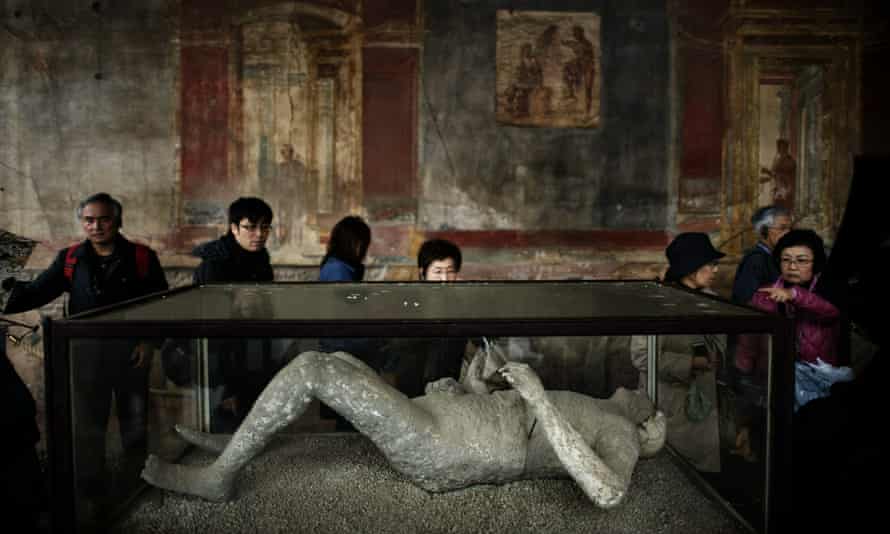
Today, visitors prove their sympathy for this pitiful, hunched Pompeian by throwing loose modify into a fountain bowl that has been placed invitingly at his side.
The urge to share our humanity with the mule man signals the enduring immediacy and emotive ability of the hundred or so plaster casts fabricated since the 19th century: the lost city's living dead. It doesn't affair that we might be looking at a reproduction. Every bit we peer through railings and dusty cabinets at the slightly twisted body of a tiny toddler or the contorted form of a dog, still struggling to break free from its neckband and chain every bit it was subsumed past the lethal surge, history seems to play out in front end of our eyes.
Thus Pompeii has the power to "plow people on to the Romans", says the renowned classicist Mary Beard. Her bestselling book and television documentaries (her second on Pompeii, New Secrets Revealed, was screened before this twelvemonth) demonstrate how scholarly research and scientific analysis such as CT scanning are busting stereotypes and enriching understanding of daily life in the town – which was less a city, as Beard points out, and more than a Saffron Walden of the Roman world. It was a prosperous withal provincial colony of the empire, with a population of somewhere between 10,000-20,000, of which around ane,150 bodies take been found.
For the archaeologist Sophie Hay, it is not merely the state of preservation that makes Pompeii so special, but the new light she and swain researchers are helping to shed on the everyday experiences of not-elite Romans – soldiers, street traders, slaves – and even those who came before the Romans. In Pompeii, the ordinary is extraordinary: old loaves of staff of life burned to a crust; disturbingly familiar-looking surgical tools.

Walking in the grooves made by Pompeians and their carts in the streets, nosotros find the ancients speaking to each other loudly and conspicuously, from the mosaic doormat spelling out Cave canem (Beware of the dog) to the graffiti they scratched on the walls: "Antiochus hung out here with his girlfriend Cithera"; "I screwed the barmaid"; "Epaphra, you are bald!"
A saying inscribed on a wall of the basilica – "A small problem gets larger if you ignore it" – looks prophetic with the volcano looming in the background. Seismic action in the area (a common occurrence, according to Pliny) was a warning to the locals that Vesuvius might blow, simply one they apparently did non heed. Pompeii was under big-scale reconstruction equally a result of an convulsion in AD63 when it was ruined again 17 years later.
The volcano had erupted before, and has done and so since, near recently in 1944. "It was the virtually majestic and terrible sight I have always seen, or ever wait to come across," recalled the travel writer Norman Lewis in his account of being a immature intelligence officeholder stationed in Naples post-obit its liberation from Nazi forces. (The allies dropped more than 150 bombs on Pompeii in 1943, causing considerable damage.)
And Vesuvius remains one of the world's most dangerous volcanoes, with millions of people living on or near its slopes, and millions more than visiting the archaeological sites every year, strangely drawn by the idea that – as the 18th-century diarist Hester Lynch Piozzi put information technology – "We, who today are spectators, may become spectacles to travellers of a succeeding century."
The more than urgent threat to Pompeii is, however, the habiliment and tear acquired by tourists and the exposure to more everyday elements than the volcano. Structural collapses acquired past heavy rains in contempo years have prompted business organization about Italy's capability to conserve this Unesco Globe Heritage Site, which was listed in 1997 and since threatened with inscription on the List of Globe Heritage in Danger.
Action has accelerated since the Eu warned terminal year that it would withdraw funding from the Not bad Pompeii Projection, a program of conservation, maintenance and restoration. The site'south superintendent, Massimo Osanna, is at pains to emphasise the enthusiasm that is now being invested aslope the euros, with architects, archaeologists and conservators difficult at work on site. None the less, the city said to have been given a second life is staring a 2nd death in the face up.
In Beard'due south view, it is better to agree back on excavation for new answers: "One-third of the boondocks is underground, and that is where it should stay, safety and sound, for the hereafter," she says. "Meanwhile nosotros can wait after the other two-thirds equally best nosotros can, delaying its collapse as far as is reasonable."
Despite the "thrill of excavation", Hay agrees: "Conservation of buildings has to take precedence over further excavation. The Pompeian scholar Paul Zanker calls for archaeologists to return to previously excavated parts of the city with new research questions in heed, and I think this is the best advice: to reassess what nosotros can learn from what is already visible, rather than excavate untouched parts of the metropolis and add together to the consequence of conservation."
Besides, the excavations have thrown upwardly more questions than they accept probably answered. Looking downwardly on the great theatre, extensively rebuilt and restored over the past century, it's difficult not to wonder if Pompeii has ever survived more in our imaginations than in the ground: a city being re-lost in the procedure of existence plant.
Do you know of other lost cities throughout history? Share stories in the comments beneath and f ollow Guardian Cities on Twitter and Facebook to join the give-and-take
Source: https://www.theguardian.com/cities/2016/aug/11/lost-cities-4-pompeii-roman-preserved-disaster-vesuvius-volcano-second-extinction
0 Response to "Metaphors Running the Family Conversation Between Them That Is Subterranean, Volcanic"
Post a Comment